Event Date
Geosynthetic Applications for Reinforcement
You will see real-world project case studies from Geosynthetics Ltd and learn how our engineering department can directly support your project.
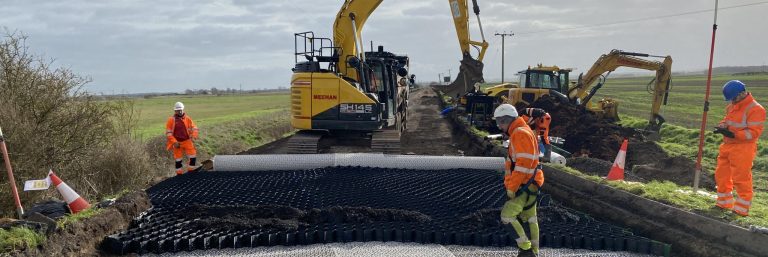
StrataWeb™ is a three-dimensional cellular confinement system manufactured from textured and perforated high-density polyethylene (HDPE) strips.
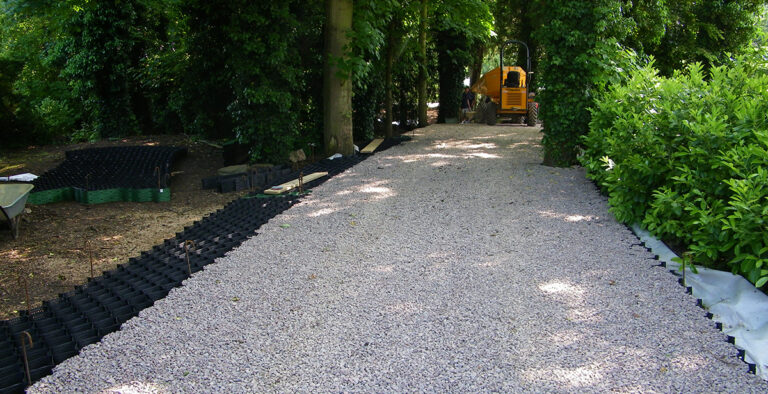
Ultrasonically welded together, this strong but lightweight plastic grid expands into a honeycomb-style structure when laid on the ground. Once filled with soil, gravel, or stone, it locks everything in place, creating a strong, stable surface that resists movement and erosion.
This makes it ideal for strengthening weak ground, supporting heavy loads, and preventing soil from washing away on slopes, walls, and drainage channels, all while being a cost-effective and easy-to-install cellular confinement solution.
StrataWeb™ confines and reinforces vegetation on steep slopes by increasing the soil’s natural resistance to erosion, and protecting the root zone layer during germination. This helps vegetation establish and remain stable over time. On non-vegetated slopes, the system prevents granular infill from migrating, improving both slope stability and visual appearance.
Its unique hoop strength and interconnecting cell walls form a durable load-spreading composite mattress that can be filled with common materials.
Perforated cell walls encourage lateral drainage, while the textured walls increase frictional interlock, increasing the structural performance of the system. StrataWeb™ can be utilised for load distribution over weak soils or areas with poor drainage to create functional, cost-effective access roads, car parks, and platforms.
Increases Structural Performance
Textured cell walls boost interlock, increasing system efficiency.
Prevents Granular Migration
Cell confinement stops infill moving, ensuring long-term stability.
Encourages Lateral Drainage
Perforated cell walls allow water to flow through the system.
Reduces Excavation Costs
Can be installed directly on existing ground, saving money.
Versatile Infill Options
Allows infill with topsoil, gravel, or concrete for various uses.
Reduces Sub-Base Depths
Creates a stiff mattress, reducing the required layer thickness.
Temporary or Permanent
Suitable for either short-term or long-term access requirements.
High Density Polyethylene
HDPE strips create a strong, lightweight, and durable panel.
Main Office
Free consulation
Strataweb does not have a single fixed “weight limit”. Its load-bearing performance depends on the cell depth, infill material, subgrade strength (CBR) and installation quality.
As a general guide, when correctly designed and installed on a suitable subgrade:
Cars & vans: ~3–9 tonnes
Refuse & construction traffic: ~30 tonnes
Heavy construction plant: up to ~50–60 tonnes (with deeper cells and engineered infill)
Strataweb works by distributing loads laterally, reducing stress on the underlying ground rather than acting as a rigid structural layer.
For exact load capacity, a site-specific engineering design is always required.
Yes — Strataweb allows water to drain, but drainage performance is dependent on the infill material.
The open 3D cellular structure does not form a waterproof barrier. When filled with free-draining granular material (such as crushed stone or gravel), Strataweb allows water to move both vertically and laterally, helping to:
If the system is filled with soil or fine compacted material, drainage performance is significantly reduced.
In short, it is the infill, not the cells, that determines how effectively water drains through the system.
On slopes and embankments, Strataweb stabilises the soil, reducing erosion and surface wash-out while creating a confined growing medium for roots. When filled with topsoil or a soil/aggregate blend and seeded, it helps vegetation take hold and remain protected during establishment.
Strataweb is manufactured from durable HDPE polymer and designed for long-term performance. Geocellular systems like Strataweb typically have an expected service life measured in decades, often 20 – 100+ years depending on material, exposure and application conditions
Yes, Strataweb can be repaired if cells are damaged (this involves replacement of sections)
If individual cells break, the damage is localised and does not result in system failure. Remedial works would typically involve:
Because Strataweb functions as a distributed confinement system, isolated damage does not compromise overall performance when correctly assessed and repaired.
Installation Guides
Our in-house engineering department offers an extensive range of geosynthetic solutions created by fully qualified and experienced civil engineers.
Wherever possible, for our stocked items, we can offer a next day delivery service, direct to site to ensure your project stays on track.
Enhance your understanding of tree root protection and sustainable construction practices by attending one of our upcoming seminars. Our expert-led sessions cover a range of topics.
We are fully committed to the success of our Builders Merchant partners. Our strategy is built on a foundation of collaboration and support, ensuring that when you succeed, we succeed.