The True Cost of “Muck-Away”: How Smarter Design Can Protect Your Project Budget
Excavation and disposal costs are some of the most frequently underestimated expenses during the early design stages of a project. In civil engineering and external works packages, the phrase “out of sight, out of mind” often leads to budgetary headaches once the ground is broken.
When working within Root Protection Areas (RPAs), these financial risks escalate. Traditional construction methods within sensitive tree-root zones can quickly blow out a project budget through deep excavation requirements, high imported fill volumes, and soaring waste disposal charges—commonly known as “muck-away.”
Fortunately, commercial efficiency and arboricultural compliance don’t have to be mutually exclusive. By rethinking the engineering approach to sub-base design, developers can protect both local tree roots and their bottom line.
The Conventional Conflict: Deep Excavation vs. BS 5837:2012
Conventional pavement construction typically relies on thick, heavily compacted Type 1 sub-base layers to achieve the load-bearing capacity required for vehicular traffic.
In sensitive tree environments, this traditional approach runs into immediate roadblocks:
- The Excavation Problem: To fit a thick Type 1 layer without raising surface levels unacceptably, contractors must dig deep into the ground.
- The Compliance Problem: Deep excavation directly violates BS 5837:2012 guidance by severing critical feeder roots and risking long-term tree damage.
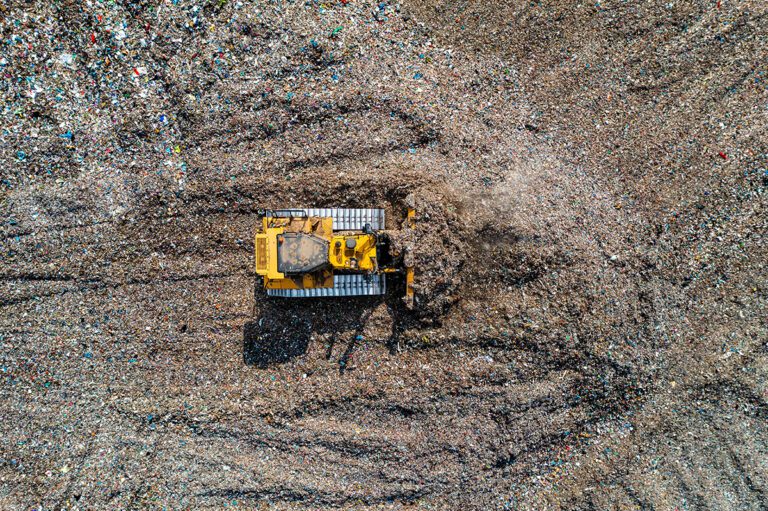
When you are forced to dig deep, you generate massive volumes of spoil that must be loaded, hauled, and disposed of off-site. On modern construction sites, escalating landfill taxes and haulage logistics can turn muck-away into one of the largest unforeseen costs in your external works budget.
The Cellweb® Solution: Cutting Sub-Base Thickness by 50%
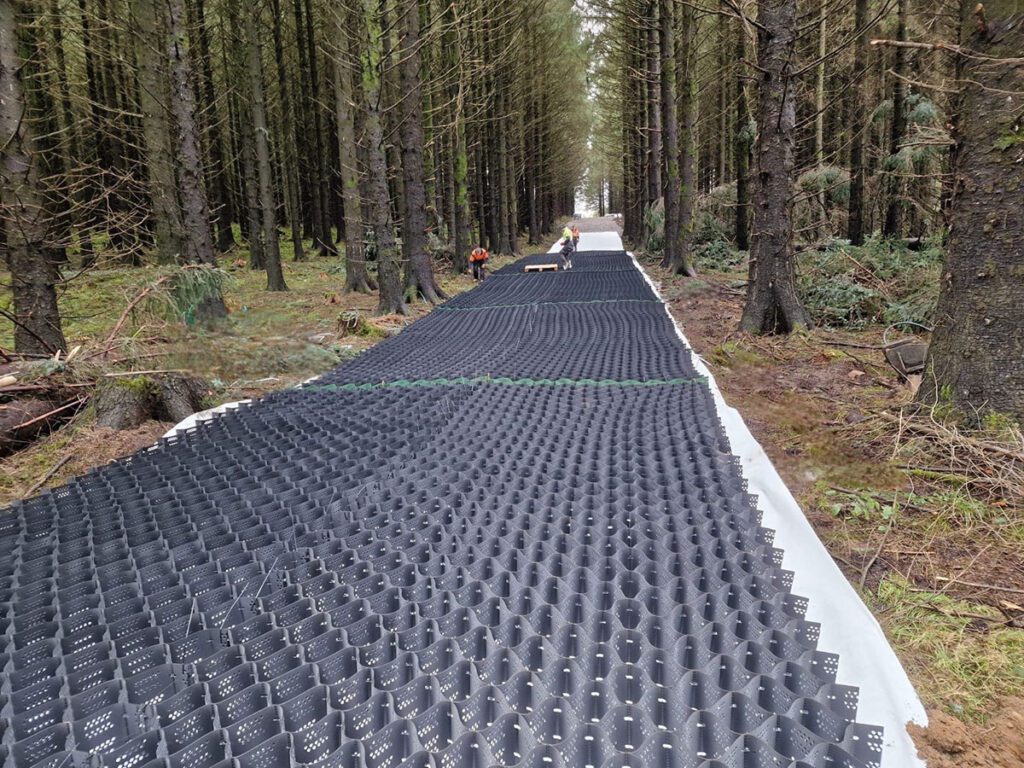
Cellweb® TRP offers a fundamentally different approach. Rather than relying on depth and compaction for strength, it relies on structural confinement.
By confining open-graded, clean aggregate within a three-dimensional cellular structure, Cellweb® TRP exponentially increases the load-distribution performance of the sub-base layer. Because the system creates a rigid, load-bearing mattress, equivalent traffic loading requirements can be achieved with substantially reduced excavation depths.
In fact, independent testing has shown that Cellweb® TRP pavement systems can reduce required sub-base thicknesses by approximately 50% when compared to traditional construction methods.
The Commercial Implications: Where the Savings Add Up
When you cut your required sub-base thickness in half, the positive financial ripple effect across your project timeline and budget is immediate:
- Reduced Excavation Volumes: Less ground needs to be broken, keeping heavy machinery away from sensitive roots and speeding up early-stage site preparation.
- Drastically Less Spoil Removal: Muck-away volumes are slashed, saving thousands in landfill fees, tipper hire, and waste disposal administration.
- Lower Imported Aggregate Quantities: Because the sub-base is thinner, you require significantly less imported clean stone to infill the system.
- Fewer Vehicle Movements: Reducing both muck-away trucks leaving the site and aggregate deliveries arriving cuts transport costs and eases local traffic management.
- Faster Installation Times: A thinner, uncompacted system goes into the ground faster, helping you stick to tight project programmes.
- Lower Carbon Impact: Fewer truck movements and reduced material processing directly lower the embodied carbon and environmental footprint of your site.
Unlocking Savings on Constrained Sites
The logistical benefits of a Cellweb® TRP “no-dig” solution become even more valuable on complex, high-density urban developments. On constrained sites where working space is at a premium, underground services are tightly packed, or construction traffic must be carefully managed, reducing the physical footprint of your excavation is a game-changer.
Furthermore, because Cellweb® TRP works using open-graded, uncompacted aggregates, it completely eliminates the need for heavy compaction plant within the RPA. This avoids further ground vibration and soil disturbance, smoothing out the path to local authority planning approval.
Value Engineering: Early Design is Key
For developers, contractors, and landscape architects, tree protection should no longer be viewed as a costly project constraint. Instead, when integrated early into the design phase, Cellweb® TRP “no-dig” solutions act as a powerful tool for value engineering—unlocking substantial programme and cost savings before a single spade hits the dirt.
Optimise Your Project’s Bottom Line
Don’t let unexpected muck-away costs compromise your project margins. Our technical engineering team can provide site-specific calculations to demonstrate exactly how much excavation depth—and budget—you can save on your next project.
Why choose Geosynthetics Ltd?
At Geosynthetics Ltd, we provide more than just materials; we provide engineer-led solutions. Our technical support team is available to help you navigate UK industry standards and ensure your project uses the most efficient, data-driven solution possible.