

Event Date
Geosynthetic Applications for Reinforcement
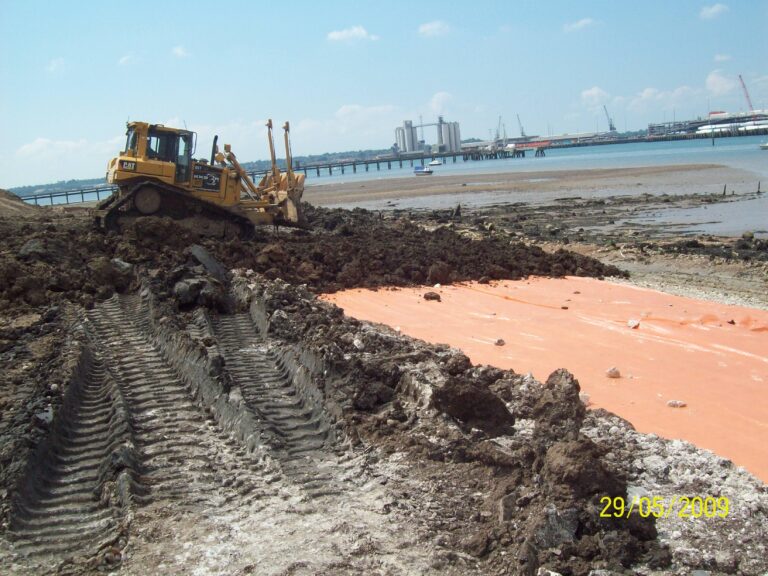
You will see real-world project case studies from Geosynthetics Ltd and learn how our engineering department can directly support your project.

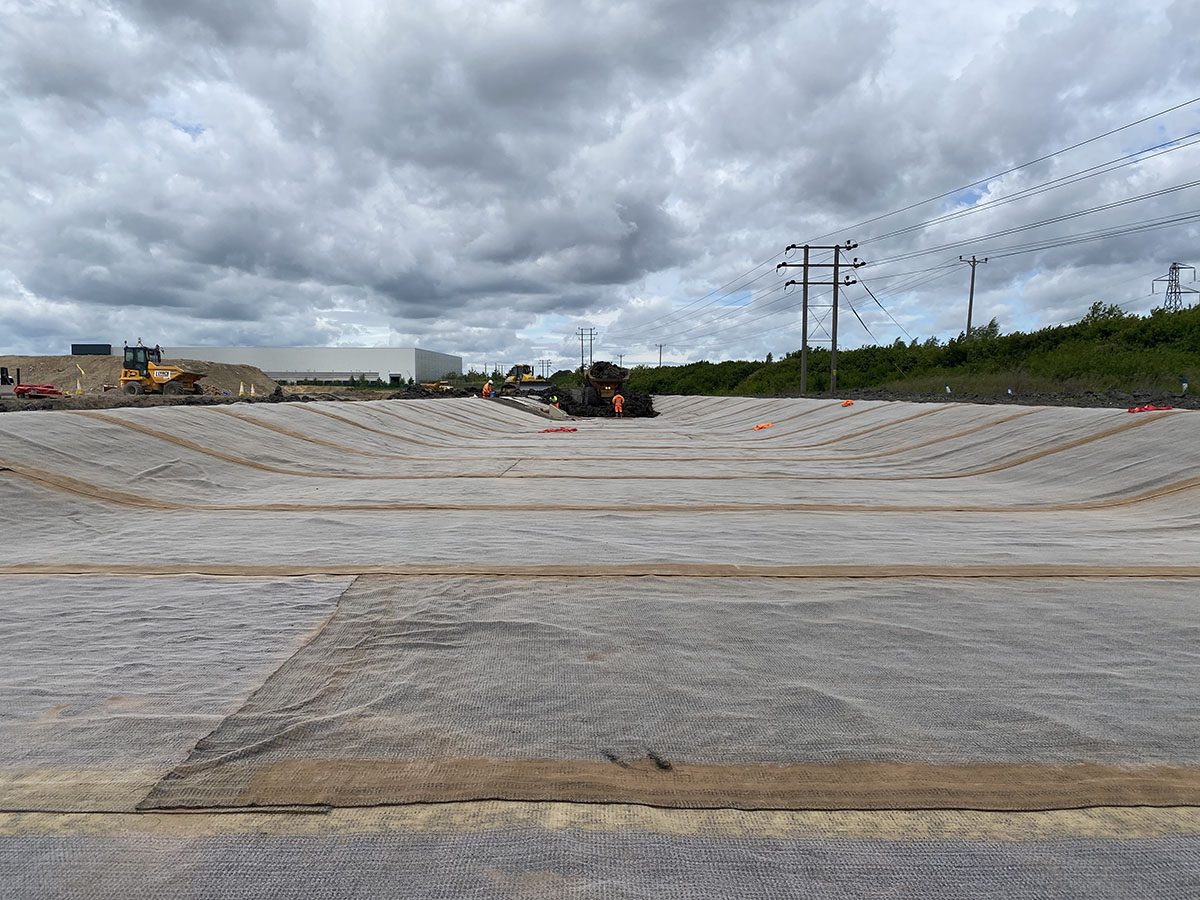
Bentotex® is a specialist geosynthetic clay liner (GCL) that acts as a high-performance hydraulic barrier for large outdoor areas, such as ponds and landfills. It works by trapping a natural sealing clay between two tough layers of fabric, forming a strong, waterproof lining that prevents leaks and protects the surrounding soil and water.
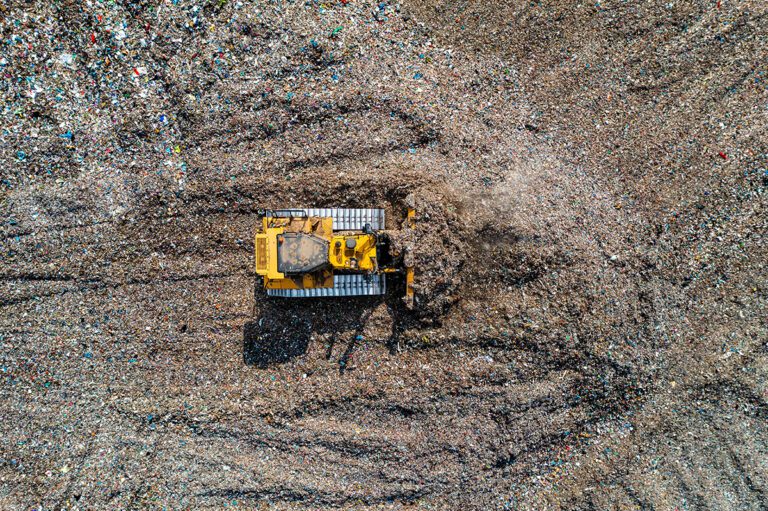
Bentotex® Bentonite Clay Liner is widely used in environmental containment applications where a low-permeability barrier is required. It is commonly specified for landfill lining systems, water containment, and groundwater protection projects.
Think of it as a fabric quilt filled with a special dry clay powder. When you roll it out and cover it with soil, any moisture makes the clay swell up to form a dense, waterproof barrier. The best part? If it gets a small hole, the swelling clay automatically plugs the gap. It’s a self-healing, easy-to-install lining solution.
The standout feature of Bentotex® GCL is its remarkable self-healing capability. When hydrated, the bentonite clay swells to seal around any minor punctures, ensuring a consistently impermeable barrier. This makes it a trusted solution for critical public works and landfill lining projects.
Unlike conventional HDPE liners, Bentotex® GCL can be installed in most weather conditions without specialist welding equipment or power, delivering significant savings on labour and plant costs. Its robust construction also resists root penetration, making it ideal for reed beds and natural water systems. For project-specific advice, contact Geosynthetics Ltd.
Unique self-healing properties
Bentonite clay swells to seal minor punctures when hydrated.
Excellent slope stability
High internal friction angle for secure slope applications.
High chemical resistance
Provides reliable containment for a wide range of leachates.
Resists differential settlement
Flexible construction accommodates ground movement without cracking.
Efficient all-weather installation
Can be deployed quickly without weather or temperature delays.
Reduces construction costs
No specialist welding plant or labour is required.
High-performance hydraulic barrier
Offers exceptionally low permeability, superior to compacted clay.
Resists root penetration
Ideal for use in reed beds and vegetated systems.
Main Office
Free consulation
Very. A ~1cm thick Bentotex in conjunction with 300mm suitable surcharge material typically provides the hydraulic containment as ~1m of compacted clay.
With suitable anchoring, yes. However, care should be taken to ensure that the surcharge material will stay at the desired slope angle, typically up to 1:3 slopes. For steeper slopes further measures must be considered. (maximum 1:1 slope)
The sodium bentonite confined between the two geotextile layers has a swell index typically 15-20x it’s original volume if hydrated when unconfined. As such, where the carrier geotextiles are penetrated or torn, the sodium bentonite will swell at the site to fill any minor gaps, hence why GCL’s are said to be self-healing. For larger gaps, loose bentonite can be applied, or for larger tears, a patch can be applied.
Sodium bentonite is volcanic ash which has been weathered in seawater and so altered to a swellable clay over time. A long time. I.e. Between 5 and 350 million years ago! The standards allow a declaration of 100years, but under normal service, they will last much longer.
It happens all the time. For landfills, space is money, so choosing a 1cm GCL over 1m of compacted clay is a complete no-brainer. It’s faster, cheaper, and saves massive amounts of void space. It’s a similar story with brownfield projects; when you’re looking at £1,200–£1,500 per wagon to haul away contaminated soil, encapsulating it in place makes much more financial sense. It solves the problem right there by breaking the source-pathway-receptor link
Yes, and it’s often used in the containment and treatment of waste liquids.
Yes. It is just natural clay encapsulated between two chemically and biologically inert geotextiles.
Yes, and carries relevant CE certification.
Brochures
Data Sheets
Installation Guides
Technicals
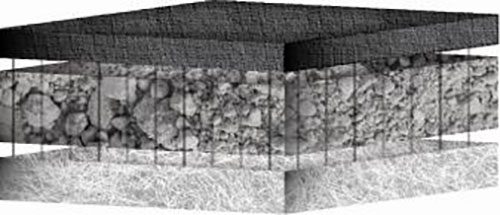
The performance of Bentotex® is centred on the unique hydraulic properties of its core material, sodium bentonite clay, which is locked between durable geotextile outer layers. The composite’s structure typically consists of a woven geotextile for tensile strength, a layer of sodium bentonite powder, and another protective geotextile. These layers are needle-punched together, a process that provides high internal shear strength and prevents the granular bentonite clay from shifting.
The primary containment mechanism is activated by hydration. When exposed to water, the sodium bentonite has an extraordinary capacity to swell to many times its original volume. As the clay particles swell, they fill the voids within the liner’s core, forming a dense and highly impermeable hydraulic barrier.
This swelling is also the source of the liner’s self-healing capability. If the GCL is punctured by a small object after installation, the hydrating bentonite from the surrounding area will expand and flow into the damaged void. This action effectively seals the puncture, maintaining the integrity of the barrier.
For this to occur, the liner requires a confining stress, which is provided by the specified minimum of 300mm of cover material that our clients are always encouraged to use.
Our in-house engineering department offers an extensive range of geosynthetic solutions created by fully qualified and experienced civil engineers.
Wherever possible, for our stocked items, we can offer a next day delivery service, direct to site to ensure your project stays on track.
Enhance your understanding of tree root protection and sustainable construction practices by attending one of our upcoming seminars. Our expert-led sessions cover a range of topics.
We are fully committed to the success of our Builders Merchant partners. Our strategy is built on a foundation of collaboration and support, ensuring that when you succeed, we succeed.