Cellweb® – 69 Church Lane – Tree Root Protection
- Location
- 69 Church Lane, Oakley, Bedfordshire
- Contractor
- Larkin Homes
- Consultant
- RGS Tree consultants
The Background
In spring 2016 Geosynthetics Ltd were contacted by Robert Yates of RGS Arboricultural Consultants regarding a new driveway at a development in Oakley, Bedfordshire.
The proposed route for the drive passed through a wooded area and therefore through the root protection areas (RPAs) of numerous trees which were to be retained. In order to maintain the health of the retained trees a no dig drive would need to be constructed.
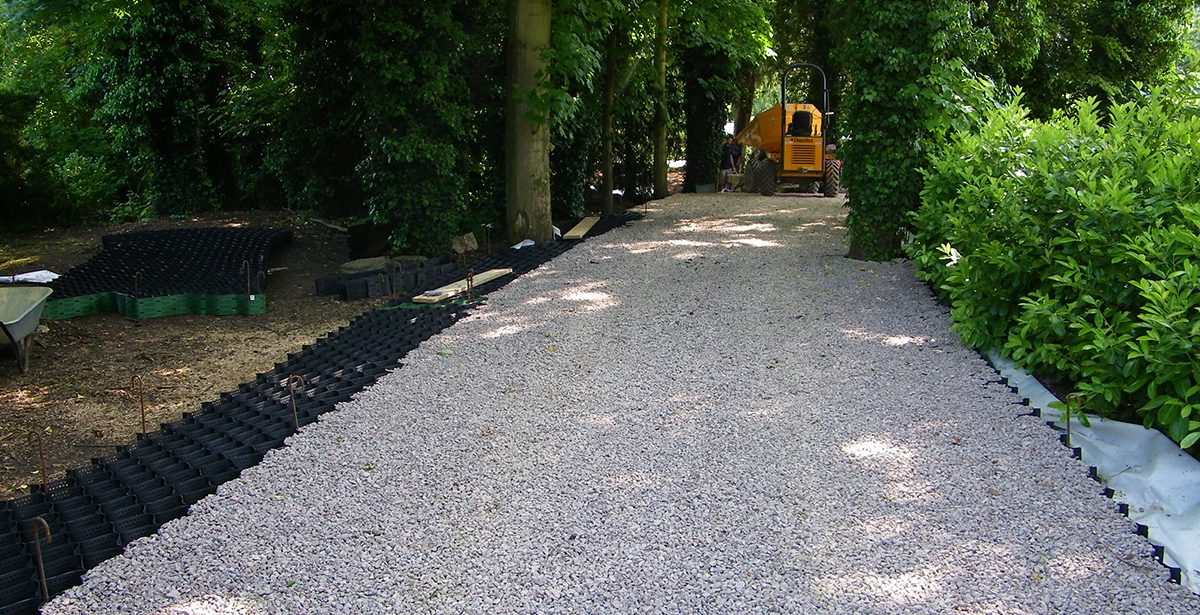
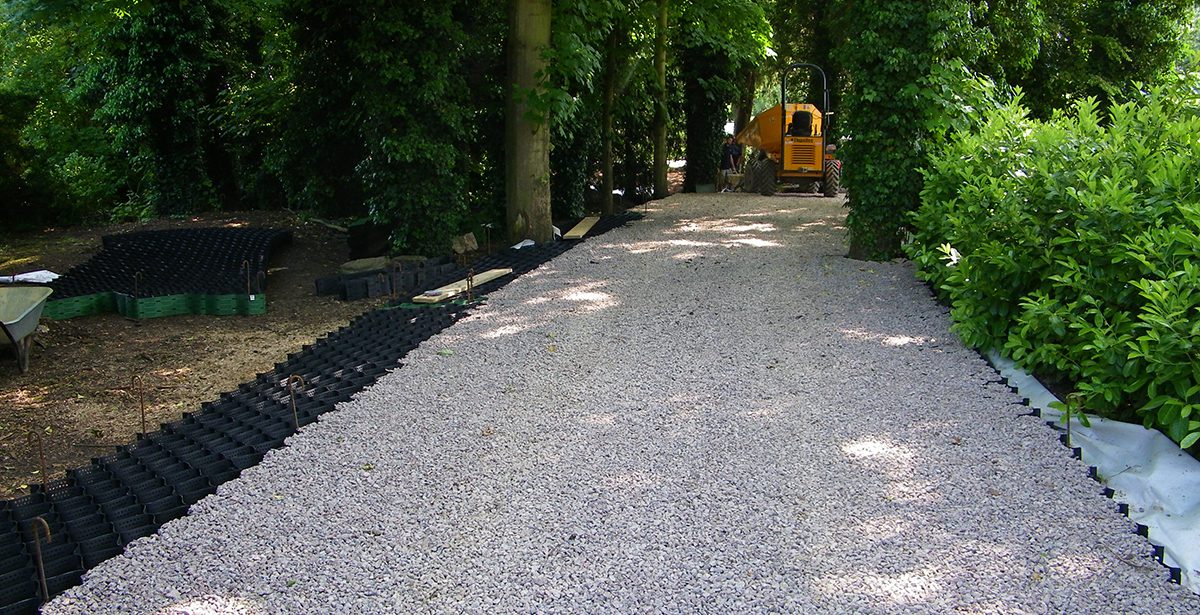
The Cellweb® Tree Root Protections system is specifically designed for the construction of new hard surfaces within RPAs. It is constructed on the existing ground surface, removing the requirement for excavation and preventing root severance.

Our Client’s Requirements
A driveway to a new development, passing through a wooded area.
The system allows continued water permeation and gas exchange by confining an open graded clean angular stone infill material.
The system is also extremely effective at spreading point loads and reducing the load that is applied to the soils beneath. This in turn minimises soil compaction maintaining an open soil structure which allows continued gas exchange, water permeation and migration.
Our Value Engineered solution
Geosynthetics Cellweb® TRP Technical Specifier met on site with Robert Yates of RGS Arboricultural Consultants and contractor, Warin Larkin of Larkin homes.
Most of the proposed route was over level ground which would lend itself to a relatively simple specification and installation, utilising a single layer of the Cellweb® Tree Root Protection system. Photo 2 shows what will become the entrance to the drive way where a section of the existing hedge will be removed, opening out onto the highway. It can be seen that this portion of the proposed driveway contains a significant fall in levels resulting in a large hollow.
Within this hollow sits the RPAs of several retained Horse Chestnuts and a large yew. As a rule of thumb a single layer of the Cellweb® TRP system should not be laid on a gradient greater than one in ten.
The client had also requested that the driveway was to be level, and these factors combined meant that the hollow would need to be infilled. Due to the presence of RPAs this would need to be achieved using a technique whereby the Cellweb® TRP system would be stacked or layered in the hollow to achieve the required build up.
During the site meeting Larkin Homes measured the depth of the hollow at its deepest point and the span of the hollow at its widest point. The remaining area of level driveway was measured and information on the proposed traffic loadings was obtained.
This information was then provided to Geosynthetics in-house engineering department so that they could prepare site specific recommendations for the driveway build up. The engineering team at Geosynthetics prepared two recommendations, one for the hollow section of the driveway and another for the remaining level section. Diagram 1 shows the recommended build up for the level section of the drive way. The 200mm depth Cellweb® was recommended based on the proposed traffic loadings which were provided and an assumed California Bearing Ratio (CBR) value of 1%. Actual CBR values for the site were unknown.


-
 Hosted by Patricia
Sustainable Engineering Solutions using Geosynthetics for Temporary and Permanent Works
This presentation details geosynthetic reinforcement solutions, focusing on the specific challenges of wind farm projects. We cover practical design methods for reinforcing access tracks and hardstanding areas, including the use of Cellweb® TRP within tree root protection zones.
We also provide a technical overview of other key applications, such as reinforced soil walls, working platforms, and embankment support. See real-world case studies from Geosynthetics Ltd and learn how our engineering department can assist with your project designs. -
 Hosted by Pablo Bernardini
Event Date
Foundation Solutions for Temporary & Permanent Works
Explore effective geosynthetic solutions for foundations on temporary and permanent works. This presentation details our complete range, of Geosynthetics systems including Geogrids, Geotextiles, Erosion Control and Drainage composites.
You will see practical construction methods and real-world case studies from Geosynthetics Ltd, demonstrating how to achieve stable, high-performance structures for challenging site conditions.
-
 Hosted by Colin Dobson
Event Date
Alternatives to Conventional Surfacing Solutions
Are you seeking robust alternatives to traditional surfacing? This presentation explores practical solutions for car parks, access roads, and specialist applications like ‘no dig’ zones, tree root protection, and green roofs. We introduce our proven product range, including Golpla grass reinforcement, Roofcell for rooftops, and heavy-duty Exopave pavers.
You will see practical construction methods and real-world case studies from Geosynthetics Ltd, demonstrating how to achieve stable, high-performance surfaces for challenging site conditions. -
 Hosted by David Middleton
Event Date
Geosynthetic solutions for common civil engineering applications
Explore effective geosynthetic solutions across the full spectrum of civil engineering challenges. This presentation details our complete range, from environmental drainage and accelerated consolidation systems to slope stabilisation and soil reinforcement.
We also cover geomembrane linings for containment and impermeable applications, plus innovative erosion control across temporary and permanent installations.
You will see practical application methods, real-world project case studies, and learn how you can leverage the technical expertise of the Geosynthetics Ltd engineering department for your specific project challenges.
-
Hosted by Colin Dobson
Tree Root Protection
Effective tree root protection is crucial for sustainable site development. This presentation zeroes in on our leading solution, Cellweb® TRP (Tree Root Protection). You will receive the core technical information and application guidance for Cellweb® TRP, ensuring compliance while maintaining soil permeability.
We showcase real-world case studies demonstrating successful installations and review the product guarantee. Learn exactly how you can leverage the expertise of the Geosynthetics Ltd engineering department to specify and implement the right system for your projects. -
 Hosted by Jamie Leake
Tree Root Protection.
Effective tree root protection is crucial for sustainable site development. This presentation zeroes in on our leading solution, Cellweb® TRP (Tree Root Protection). You will receive the core technical information and application guidance for Cellweb® TRP, ensuring compliance while maintaining soil permeability.
We showcase real-world case studies demonstrating successful installations and review the product guarantee. Learn exactly how you can leverage the expertise of the Geosynthetics Ltd engineering department to specify and implement the right system for your projects. -
Hosted by David Middleton
Event Date
Geosynthetic Applications for Reinforcement
Discover a wide range of geosynthetic reinforcement solutions in this technical presentation. We cover practical applications from retaining walls, and reinforced slopes to foundations and working platforms and erosion control systems.
You will see real-world project case studies from Geosynthetics Ltd and learn how our engineering department can directly support your project.